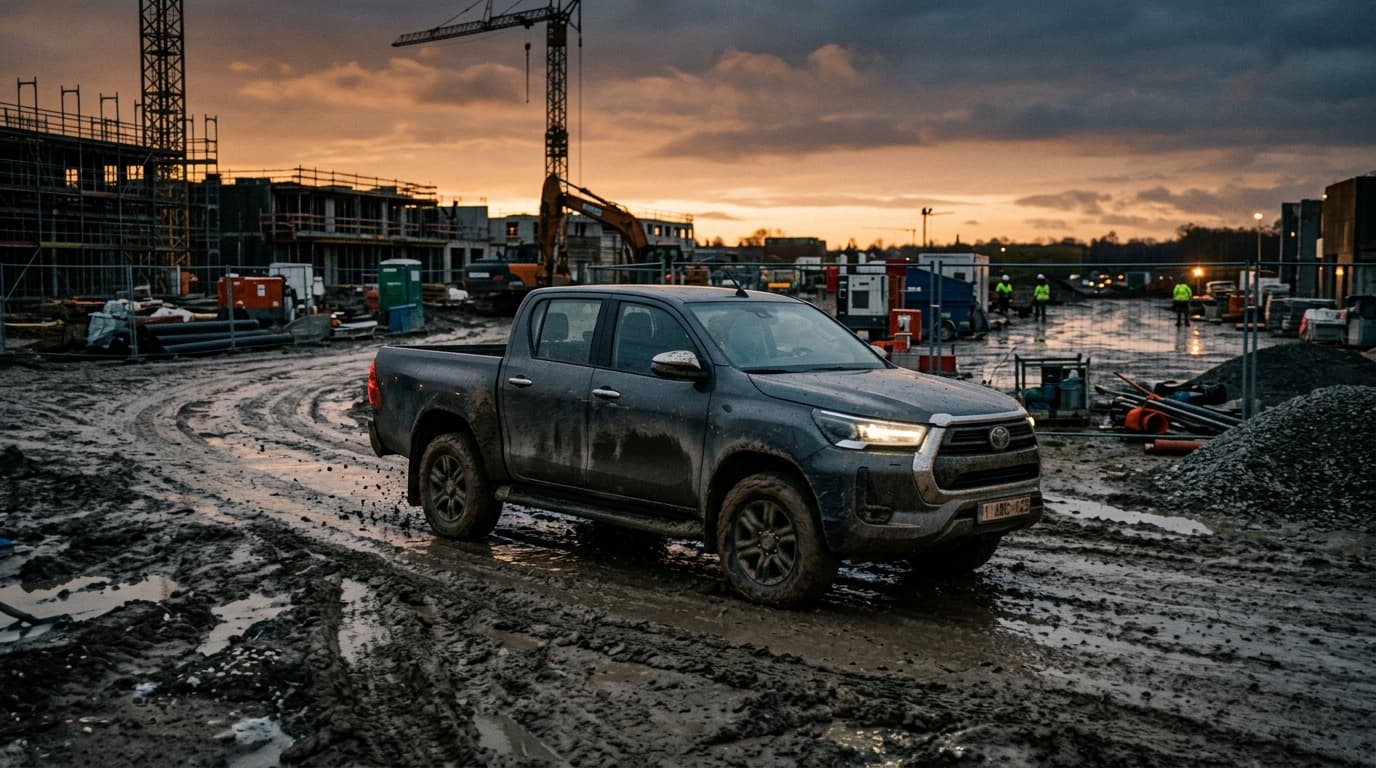
The Ford Ranger sold in Belgium in October 2026 has little in common with the one you could buy two years ago. The 2.0 diesel has left the price list, the plug-in hybrid costs barely more than the V6, and the real choice is made on the scales. I checked prices, weights and taxes version by version.
Six versions on the Belgian list, and none below €50,000 excluding VAT
The price list Ford Belgium published on 7 July 2026, reference B26-P28, covers model year 2027. It fits on one page. Double cab only, four trims, two engines: the 240 hp 3.0 V6 EcoBlue diesel and the 281 hp 2.3 plug-in hybrid, both with a ten-speed automatic and four-wheel drive, both Euro 6e-bis.
No single cab, no super cab, no XL or XLT trim, and no more 2.0 EcoBlue. The German ADAC catalogue ends the Ranger 2.0 in December 2025. Anyone looking for a new Ranger under €40,000 excluding VAT, the entry price still quoted everywhere in 2025, will only find one in dealer stock or used.
| Trim | Engine | Price excl. VAT | Price incl. VAT (calculated) | WLTP CO₂ |
|---|---|---|---|---|
| Limited | 3.0 V6 diesel, 240 hp | €50,300 | €60,863 | 273 to 317 g/km |
| Limited | 2.3 PHEV, 281 hp | €51,025 | €61,740 | 146 g/km |
| Wildtrak | 3.0 V6 diesel, 240 hp | €52,800 | €63,888 | 270 to 318 g/km |
| Wildtrak | 2.3 PHEV, 281 hp | €53,525 | €64,765 | 146 g/km |
| Platinum | 3.0 V6 diesel, 240 hp | €55,800 | €67,518 | 273 g/km |
| Platinum | 2.3 PHEV, 281 hp | €56,525 | €68,395 | 146 g/km |
| MS-RT | 3.0 V6 diesel, 240 hp | €62,050 | €75,081 | 284 g/km |
| MS-RT | 2.3 PHEV, 281 hp | €62,775 | €75,958 | 152 g/km |
Ford Belgium list prices, list B26-P28; VAT-inclusive column calculated by us at 21% and rounded to the euro.
Nobody pays list price. On its professional page, Ford advertises for orders from 1 October to 14 December 2026 a Wildtrak PHEV at €43,405 excluding VAT (a €7,120 trade discount plus a €3,000 stock bonus) and a Limited V6 at €42,139 (€5,661 discount plus €2,500 bonus). That is 18.9% and 16.2% below list.
The Ranger remains the segment benchmark here: in 2024 Ford claimed a 50.1% share of the Belgian pickup market, based on S&P Global Mobility data. One pickup in two.
Why does the PHEV cost only €725 more than the V6?
At the same trim, the gap between the V6 diesel and the plug-in hybrid is €725 excluding VAT, on all four lines of the list. When Moniteur Automobile tested the PHEV in June 2025, it put it about €5,000 above a four-cylinder diesel. The comparison has changed base: the entry diesel has gone, and the PHEV is now measured against the V6, the most expensive engine of the old range.
For €725, the PHEV brings 697 Nm of torque instead of 600, around forty kilometres on electricity (43 km WLTP according to Ford) and the Pro Power Onboard option, which turns the bed into a generator. The 6.9 kW Cargo Pack that includes it is listed at €1,950 excluding VAT. Two 3.45 kW sockets on a site with no mains supply means a circular saw and a compressor running without a generator in the back.
The PHEV also has limits that are not in the price. Its onboard charger tops out at 3.6 kW, with no fast charging: count on about four hours on a reinforced socket, according to Moniteur Automobile. It only makes sense if you charge at the depot or at home every night.
And one figure has doubled without the vehicle changing. At launch, in June 2025, Ford claimed 70 to 72 g of CO₂ and 3.1 to 3.2 litres per 100 km. The Belgian list of July 2026 shows 146 g and 6.4 litres for the same engine. The gap comes from the Euro 6e-bis standard, which revises how electric kilometres are weighted in plug-in hybrid homologation. For a professional with a light commercial vehicle, it does not change the tax. For a private buyer, it does.
The PHEV's payload: one tonne on paper, how much on the scales?
In its June 2025 release, Ford claims a payload of "up to one tonne" for the Ranger PHEV, with no loss compared with the diesel. The Belgian price list gives a minimum kerb weight of 2,718 kg for the PHEV and 2,368 kg for the V6. That 350 kg gap is the 16.5 kWh gross battery and its electric motor.
Both statements only hold together if the PHEV's maximum authorised mass is clearly higher than the V6's. Yet a commercial vehicle you drive on a category B licence is capped at 3,500 kg. On that ceiling, 3,500 minus 2,718 leaves 782 kg, driver included, and that is a maximum calculated on the lowest kerb weight, before any accessory. Add a hardtop, a towbar and an electric roller cover, and you go lower.
For the V6, the old 2023 Belgian brochure gave a maximum authorised mass of 3,350 kg in double cab. With the 2,368 kg kerb weight of the current list, that comes to around 980 kg. More consistent with the tonne claimed.
I did not find the model year 2027 PHEV's maximum authorised mass in the Belgian documents published. It appears in box F.2 of the registration certificate and on the certificate of conformity: ask the dealer for it, in writing, before signing. In the fleet, we weighed every new vehicle on a builders' merchant's weighbridge before giving it any load at all.
For a tradesperson carrying cement bags, paving slabs or a tank, those 200 kg of uncertainty decide between a V6 and a PHEV. Our article on van payload and the category B licence explains how to read the certificate.
Towing 3.5 tonnes with the V6, if you hold the right licence
Both engines are homologated for 3,500 kg of braked trailer. Two caveats.
The gross train weight first: 6,500 kg for the V6 double cab according to the old Belgian brochure. With 3.5 tonnes behind, the pickup itself can only weigh 3,000 kg, which leaves 632 kg on board, passengers included. The calculation is detailed in our page on pickup gross train weight.
The licence next. A B licence stops at a 750 kg trailer or a 3,500 kg combination (4,250 kg with code 96). Towing 3.5 tonnes therefore requires a BE licence, as we explain for towing a trailer with a van.
Fuel use: 6.4 litres homologated, 7.7 logged by an owner
Test figures agree with each other, and they are far from the spec sheet. Moniteur Automobile measured 5.7 litres per 100 km on the road starting with a full battery, 10 to 12 litres off-road, and an 8.7 litre average over its June 2025 test. Automobile Propre recorded 8.9 litres over 200 km in September 2025, also starting fully charged.
A German owner logging his Wildtrak PHEV on Spritmonitor covered 4,583 km between 4 June and 2 August 2026, with eight fuel fills and fourteen charges: 7.65 litres per 100 km on average, about the same in town (7.18) as on the motorway (7.70). He charges, but not after every trip, which is the most common profile among self-employed drivers.
The V6 diesel is homologated at 10.3 to 12.1 litres depending on trim. We found no recent independent measurement of the 2027 version. Its strength lies elsewhere: it depends on no socket, and on a 300 km day with a trailer, it is the one that finishes without calculation.
Is the Raptor still a commercial vehicle?
For tax purposes it can be: it is an open-bed pickup, registered as a light commercial vehicle according to its certificate of conformity, and the Belgian regime follows the body, not the power. In practice, much less so.
The 2023 Belgian brochure gave it a 292 hp 3.0 V6 EcoBoost petrol engine, a 652 kg payload and a braked trailer limited to 2,500 kg, against 3,500 kg for other Rangers. Its bed has the same dimensions as the Wildtrak's, but its long-travel suspension and all-terrain tyres are made for sand, not for a site trailer.
Above all, the Raptor no longer appears on the Belgian B26-P28 price list. In the Netherlands, Ford lists it from €85,900 excluding VAT, Dutch registration tax included, according to Autozine. In Belgium you have to go through a dealer and available stock. For a professional, it is a pleasure purchase financed by recoverable VAT, and I would say so plainly to my accountant.
Tax: €148.76 a year in Wallonia, €197.75 in Flanders
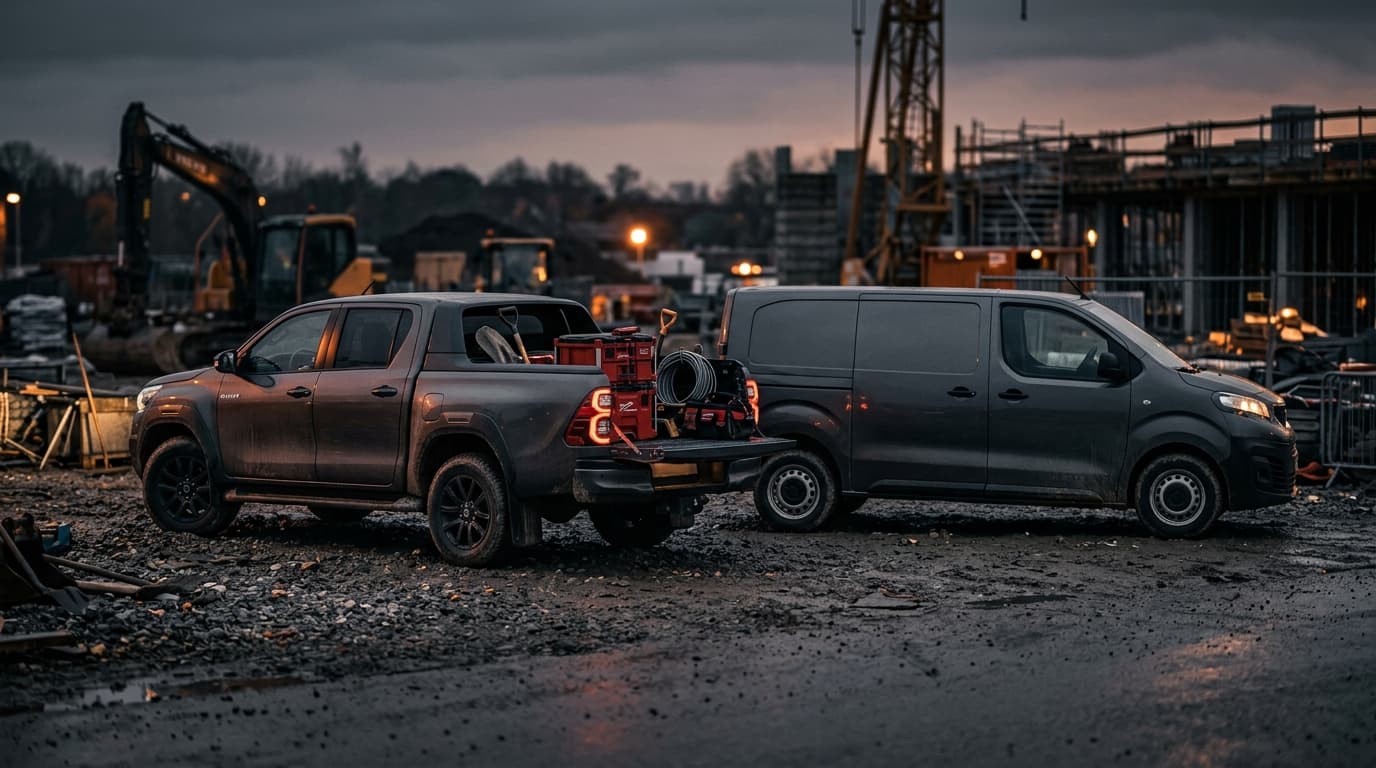
For a professional, the Ranger is taxed as a light commercial vehicle in all three regions, provided it is registered to a company or a self-employed person listed with the Crossroads Bank for Enterprises. No registration tax. An annual tax based on maximum authorised mass, and every Ranger falls in the 3,001 to 3,500 kg band, whatever the powertrain.
For a private individual, the picture changes completely in Wallonia (since 1 January 2022) and Flanders (since 1 January 2023): a pickup registered on a national register number is taxed like a car. Moniteur Automobile put the PHEV's registration tax at over €7,000 in Wallonia in June 2025, against about €700 in Flanders, where it depends on CO₂ and Euro standard.
| Region | Registration tax (business) | Annual tax (business, 3,001 to 3,500 kg) | Private individual |
|---|---|---|---|
| Wallonia | €0 | €148.76 from 1 July 2026 to 30 June 2027 | Taxed like a car since 2022 |
| Flanders | €0 | €197.75 (Euro 6) since 1 July 2026, a 30% cut announced from 1 January 2027 | Taxed like a car since 2023 |
| Brussels | €0 | Scale by mass band published on mytax.brussels, not checked for this article | No equivalent rule found; check with Brussels Fiscalité |
Sources: Walloon commercial vehicle scale; Flemish light commercial vehicle rate.
On VAT and income tax, the hybrid Ranger has no advantage over the diesel, and no handicap. As a light commercial vehicle, it recovers VAT in proportion to business use and stays 100% deductible, outside the company car regime. On the Wildtrak PHEV on offer, VAT comes to €9,115; on the Limited V6, €8,849.
One point applies to every double-cab pickup. Since the programme law of 27 December 2005, the Belgian tax definition of a light commercial vehicle requires a load area of at least 50% of the wheelbase, and the Finance Minister refused any exemption in his answer to Senate written question no. 4-121 in 2008; the question noted that pickups are treated separately. The standard Ranger has been registered as a light commercial vehicle in Belgium for years. A conversion (a bench in the bed, a fixed camper unit) can put it all in question.
Two recalls to check before buying, new or used
This generation of Ranger is not free of faults, and two campaigns directly concern the European market.
The first affects the 2.0 EcoBlue diesel. Auto Motor und Sport reported a recall of Rangers built between 2022 and 2023, about 20,400 worldwide including 3,178 in Germany: insufficient cleaning of the crankcase can leave machining residue in the oil circuit, with a risk of oil starvation and seizure. Free inspection and cleaning at a workshop. It is the engine you will find on recent used vehicles, since it is no longer on the new price list.
The second is software. According to Autohaus, KBA recall 15443R (Ford code 25S77) covers 340,756 Rangers built between 27 June 2024 and 24 June 2025, including 8,524 in Germany: brake assistance can fail, which clearly lengthens stopping distance. A free update of the brake module.
Before signing, for a stock vehicle or a used one, have the dealer check a few points:
- the chassis number run through Ford's system for open recall campaigns, with written proof;
- the maximum authorised mass in box F.2 and the real kerb weight, to know your payload before buying accessories;
- the N1 category and pickup body entry on the certificate of conformity;
- the gross train weight, if you plan to tow more than 2.5 tonnes;
- for a PHEV, the type of socket available where the vehicle sleeps.
The warranty stated on the Belgian list is 2 + 1 years or 100,000 km, plus 12 years against corrosion, and 8 years or 160,000 km for the PHEV battery at a 70% capacity threshold. For comparison, a Hilux remains the pickup that inspires most confidence at 250,000 km; the Ranger plays more on technology and equipment.
Which Ranger should you take?
The Limited V6 on offer at €42,139 excluding VAT is the sensible way in: it tows 3.5 tonnes, carries close to a tonne and needs no infrastructure. It is the one I would put in a site fleet.
The Wildtrak PHEV, at €43,405 excluding VAT on offer, is the best buy in the range for anyone who charges every night and does most of their day within 40 electric kilometres, in town or on the outskirts. It also comes first if Pro Power Onboard saves you a generator. On one condition: know its maximum authorised mass before loading it.
The Platinum and the MS-RT add nothing for work, one comfort, the other rally styling without a single extra horsepower. The Raptor is a hobby. And if you are still hesitating with the Volkswagen Amarok, built by Ford at Silverton on the same base, or with the Hilux, our Ranger, Hilux or Amarok comparison sets out the match, and the pickup ranking covers the whole segment. For the hybrid against electric models, see hybrid or electric pickup.
Sources: Ford Belgium, Ranger double cab price list B26-P28, published 7 July 2026, and professional offers valid from 1 October to 14 December 2026 (renting until 31 October 2026); Ford Belgium, Ranger brochure model year 2023.75 (weights, bed dimensions, Raptor); Ford of Europe, releases of 13 February 2025 (2024 sales, Belgian market share) and 12 June 2025 (Ranger PHEV); ADAC, fourth-generation Ford Ranger catalogue; Moniteur Automobile, Ranger PHEV test, 19 June 2025; Automobile Propre, Ranger PHEV test, 6 September 2025; Spritmonitor, log of a Ranger 2.3 PHEV Wildtrak, June to August 2026; Autozine, Dutch Ranger 2026 prices; Auto Motor und Sport, 2.0 EcoBlue recall; Autohaus, recall of 19 September 2025; SPW Fiscalité, commercial vehicle scale 2026-2027; Vlaanderen.be, light commercial vehicle rate from 1 July 2026 and pickup regime; Belgian Senate, written question no. 4-121 of 11 January 2008. Prices and pages checked on 17 October 2026. List prices and discounts may change: confirm them with your Ford dealer.
Pick-up comparator
Compare all pick-up side by side.
Compare now →
Frequently asked questions

Damien, 44 ans, a géré pendant douze ans la flotte d'utilitaires d'une PME de second œuvre dans la région de Namur : achats, entretien, revente, et les galères de carrosserie qui vont avec. Il a vu passer des dizaines de Trafic, Transporter et Master, et il sait ce qui casse, ce qui se revend bien et ce qui coûte cher à l'usage. Il a lancé ce site pour comparer les utilitaires sur ce qui compte vraiment en Belgique : charge utile réelle, volume utile, TVA récupérable et coût au kilomètre — pas la brochure du concessionnaire.