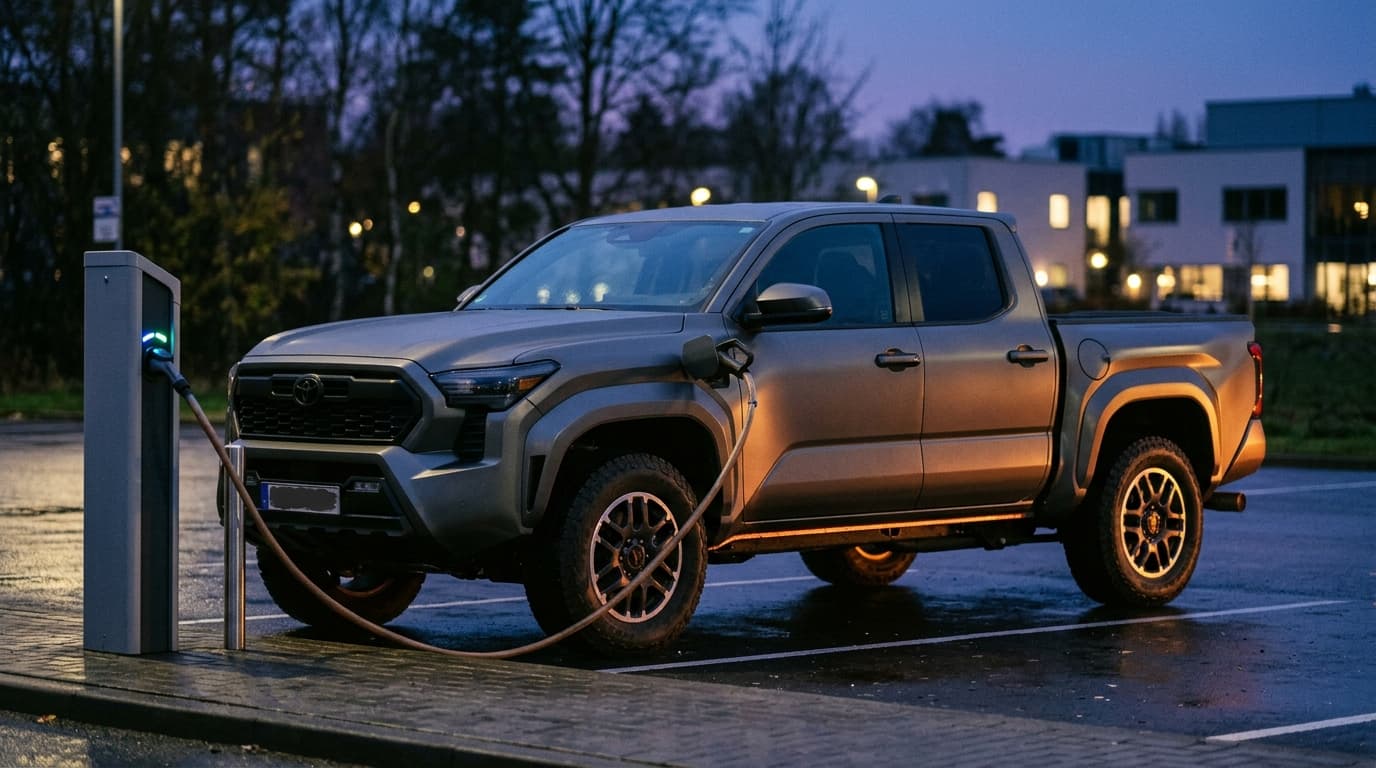
The right electrified pickup comes down to one thing: what you tow and where you drive. For site work with a trailer and long runs, the plug-in hybrid stays in charge. For urban rounds with depot charging, the fully electric option becomes credible — and erases the low-emission-zone question.
Hybrid or electric pickup: which one in short?
Take the plug-in hybrid if you tow often and drive outside cities: the Ford Ranger PHEV keeps the diesel's 3,500 kg towing and switches to electric downtown. Take the fully electric option if your days are urban, predictable and you charge at the depot overnight: the KGM Musso EV or the Isuzu D-Max EV get through everywhere, with no LEZ fine.
On a real job site, the real question is not the badge but range under load. An electric pickup rated at 300 km WLTP drops fast below 200 km when loaded, and far lower with a 2-tonne trailer behind. The plug-in hybrid sidesteps that wall: it runs on electric through town, then pulls on combustion when it counts.
What really separates these vehicles: towing capacity, ex-VAT price and real charging access. The rest — the BYD Shark 6's 430 hp, the screens — matters little when you load materials all day.
What exactly is a plug-in hybrid pickup?
A plug-in hybrid pickup (PHEV) pairs a combustion engine with a battery you plug into the mains. It runs fully electric over a limited distance — 43 km for the Ranger PHEV, up to 90 km for the BYD Shark 6 — then behaves like a conventional hybrid once the battery is empty.
The difference with a "mild hybrid" (the Toyota Hilux 48V, for instance) is clear: the 48V does not charge from a socket and offers no real electric range. It smooths fuel use, nothing more. The PHEV allows genuine urban rounds without a drop of fuel — provided you recharge it every night. Without regular charging, a PHEV lugs a heavy battery for nothing and burns more than a diesel.
The number that matters: real WLTP electric range. Count on 70 to 80% of the quoted figure in everyday use. The BYD Shark 6's 90 km therefore holds around 65 to 70 km in practice — enough for most urban tradespeople's days. The Ranger PHEV's 43 km drops toward 30 to 35 km: fine for town, tight for a peri-urban round trip.
Which hybrid and electric pickups are available in Belgium?
The offer changed face in 2025-2026. On the plug-in hybrid side, the Ford Ranger PHEV is already at dealers; the BYD Shark 6 follows close behind. On the fully electric side, four models share the ground, from the most affordable to the most capable.
| Model | Type | Electric range | Max towing | Indicative price (BE) |
|---|---|---|---|---|
| Ford Ranger PHEV | Plug-in hybrid | ~43 km WLTP | 3,500 kg | from ~€43,500 ex-VAT |
| BYD Shark 6 | Plug-in hybrid | ~90 km WLTP | ~2,500 kg | from ~€55,500 (outside BE) |
| KGM Musso EV | Fully electric | ~330 km WLTP | modest | €44,490 |
| Maxus T90 EV | Fully electric | ~330 km WLTP | limited (~1,000 kg payload) | €54,990 ex-VAT |
| Maxus eTerron 9 | Fully electric | ~430 km WLTP | 3,500 kg | from ~€67,954 |
| Isuzu D-Max EV | Fully electric | ~ professional use | 3,500 kg | from €71,015 ex-VAT |
The KGM Musso EV (formerly SsangYong) plays the price card: at €44,490, it is the cheapest electric pickup in the country, with a 207 to 237 hp motor depending on the drivetrain. The Maxus T90 EV targets the light urban user, but its limited payload and towing rule it out for real site work. The Isuzu D-Max EV is the opposite: dual-motor all-wheel drive, 3.5 t towing, professional capability — but an entry ticket of €71,015 ex-VAT, about €32,000 more than the equivalent diesel D-Max.
On the Belgian market, the Isuzu D-Max has been available since October 2025, but you will not see many: volumes stay marginal. The Maxus eTerron 9, expected from mid-2026, is the most promising on paper — a 102 kWh battery and 3.5 t towing — but it needs to be judged in use before any verdict.
Can an electric pickup really tow 3.5 tonnes?
Yes, but only a few models — and at the cost of collapsing range. The Isuzu D-Max EV and the Maxus eTerron 9 are homologated at 3,500 kg braked, like a diesel pickup. The Maxus T90 EV does not play in that league: its payload tops out around 1,000 kg and its towing is well below.
The catch is physics. Pulling 2 to 3 tonnes doubles, sometimes triples the energy use of an electric vehicle. A D-Max EV rated at 260 km unladen can drop below 120 km with a loaded site trailer. On a long run, you spend more time at the charger than at work. This is where the plug-in hybrid regains the advantage: the Ranger PHEV keeps its 3,500 kg and its combustion range when towing.
What we would avoid: buying an electric pickup to tow regularly without mapping your charging points along the route. Unladen in town, electric is unbeatable; hitched up on the motorway, it becomes a constraint.
How much does a hybrid or electric pickup cost in Belgium?
The entry ticket ranges from single to double. The KGM Musso EV opens at €44,490, the Maxus T90 EV at €54,990 ex-VAT, the Maxus eTerron 9 around €67,954, and the Isuzu D-Max EV climbs to €71,015 ex-VAT. On the plug-in hybrid side, the Ford Ranger PHEV sits around €43,500 to €46,400 ex-VAT depending on promotions, and the BYD Shark 6 is announced from around €55,500 in European markets already served.
These gaps reflect real capability. A cheap Musso EV or T90 EV does not tow like a D-Max EV. Paying €71,015 for the Isuzu makes sense if you need the 3.5 t and all-wheel drive; otherwise it is expensive for urban use. The Isuzu also costs about €32,000 more than the same D-Max in diesel — a premium only a fully urban use with depot charging starts to pay back.
Does the PHEV or electric pickup clear low-emission zones?
Yes, and it is the number-one argument for electrification for a Belgian pro. A fully electric pickup is exempt from low-emission zones, everywhere and with no expiry date. A plug-in hybrid drives in electric mode in these zones, and its recent (Euro 6) combustion engine is tolerated today anyway.
The tightening is sharpest in Brussels. Since 1 January 2026, Euro 5 diesel is banned in the Brussels LEZ, with fines landing from July 2026 at €350 per year. An old diesel pickup becomes a budget risk in the city centre; an electric one erases the question for good. In Flanders, Antwerp and Ghent have postponed their tightening — Euro 5 diesel is still tolerated there in 2026 — but the trajectory is the same everywhere.
On the Belgian market, it is often this factor, more than the fuel, that triggers the move to electrified among Brussels tradespeople. If you work mainly within the city, guaranteed access to regulated zones is worth a lot.
Can you recover VAT and deduct an electrified pickup?
This is the point that tips the balance. A pickup homologated as a light commercial vehicle (N1) and used mainly to transport goods opens the right to VAT recovery, in proportion to demonstrated professional use. Diesel, hybrid or electric: the regime is the same.
Better still: unlike company cars hit by the 2026 tax reform, light commercial vehicles homologated N1 — up to 3.5 t — stay 100% deductible for income tax, whatever the powertrain. An N1 electric pickup therefore combines LEZ exemption with full deductibility: the best of both worlds, provided the homologation holds.
Should you fall for the BYD Shark 6 over the Ranger PHEV?
On paper, the BYD Shark 6 crushes the Ford Ranger PHEV: 430 hp against 279, 90 km of electric range against 43, a 32.2 kWh LFP Blade battery, 23 g of CO₂/km and a 0-100 km/h in 5.7 seconds. It charges at 11 kW three-phase (15 to 100% in 3 h 20) and accepts 55 kW DC. For urban and peri-urban use, it is a very serious proposition.
But two reservations count for a pro. First, towing: around 2,500 kg for the Shark, against 3,500 kg for the Ranger PHEV. If you pull a loaded site trailer, the gap is disqualifying. Second, network and resale: Ford has a dense service network in Belgium and an established used value, whereas BYD remains a newcomer whose residual value is still unknown.
At resale, a well-maintained ex-fleet Ranger resells easily on the Belgian market. A recent Chinese pickup, we do not know yet. For a sole trader reselling at three or four years, that uncertainty carries a real cost no spec sheet shows.
Our verdict
Pickup electrification is no longer a promise: in 2026, a Belgian tradesperson can choose between the plug-in hybrid, which keeps combustion versatility, and the fully electric, which erases low-emission zones. The right call rests on your mileage, your towing and your charging access — not on the most flattering spec sheet. For site work with a trailer, the Ranger PHEV remains the sensible bet. For urban rounds charged at the depot, the D-Max EV or the Musso EV hold up. And in every case, N1 homologation decides the real price.
To compare with diesel pickups, see our Ranger, Hilux and Amarok comparison. If you are still hesitating between a pickup and a van, the pickup or van guide settles the question, and the electric van comparison widens the picture. Not sure of your segment? A short quiz points you in the right direction.
Sources: FEBIAC (2025 light commercial vehicle registrations, +7.6%); Autofans and La DH (KGM Musso EV and Isuzu D-Max EV reviews and availability, Belgium 2025-2026); Moniteur Automobile and Motor1 (BYD Shark 6 specifications and European launch, 2026); Ford Belgium (Ranger PHEV, ex-VAT pro prices 2026); Accountable and Athlon Belgium (N1 light commercial vehicle deductibility and VAT, 2026); Brussels Environment (Euro 5 diesel LEZ, 2026).
Pick-up comparator
Compare all pick-up side by side.
Compare now →
Frequently asked questions

Damien, 44 ans, a géré pendant douze ans la flotte d'utilitaires d'une PME de second œuvre dans la région de Namur : achats, entretien, revente, et les galères de carrosserie qui vont avec. Il a vu passer des dizaines de Trafic, Transporter et Master, et il sait ce qui casse, ce qui se revend bien et ce qui coûte cher à l'usage. Il a lancé ce site pour comparer les utilitaires sur ce qui compte vraiment en Belgique : charge utile réelle, volume utile, TVA récupérable et coût au kilomètre — pas la brochure du concessionnaire.