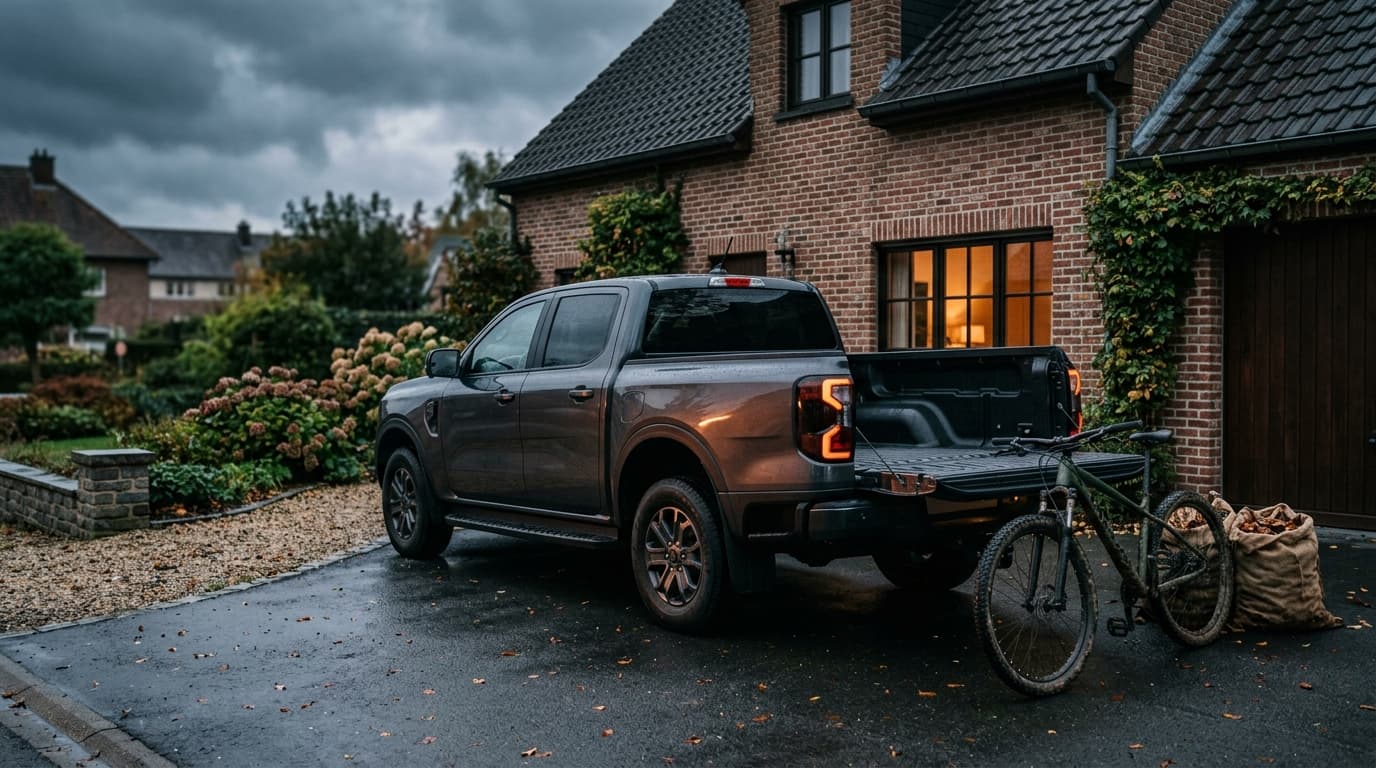
Without a business number, a pickup now costs more than an equivalent SUV in Belgium. All three regions have closed the loophole: Wallonia in 2022, Flanders in 2023, Brussels since 1 January 2025. A private buyer's Ford Ranger now means up to €6,054 in registration tax instead of zero.
A pickup as a private buyer: worth it in short?
If you were buying a pickup for the tax treatment, that deal is dead. What made the pickup attractive to Belgian private buyers was a van rate applied to a leisure vehicle. That rate no longer exists for you. If you are buying it for the bed and the 3,500 kg of towing, and you accept the bill, the reasoning still holds.
The pickup was never very rational for private use: bulky, thirsty, less comfortable than a car at the same budget. What offset all that was a laughable tax bill. A modest Isuzu D-Max and a big-V8 RAM 1500 paid the same — a few dozen euros a year, no registration tax.
The number that matters: around 65,000 pickups were on Belgian roads in 2021, 63% more than ten years earlier. Per capita, that was twice as many as in France or Germany, and ten times as many as in the Netherlands. That gap was not down to a Belgian taste for open beds — it was the tax line.
What is a fiscal van in Belgium?
A fiscal van is a vehicle of 3,500 kg maximum whose load area reaches at least 50% of the wheelbase length, with a fixed horizontal floor free of any anchor point for seats or seatbelts. The pickup ticks those boxes by design.
Until the reforms, that qualification opened two massive advantages: no registration tax at all, and a flat annual tax based on maximum authorised mass, roughly €35 to €150. Neither engine size, nor fuel, nor CO₂ entered the calculation. Hence the anomaly: a 5.7-litre V8 cost less in tax than a petrol city car.
Since the reforms, the technical definition has not moved — it is the buyer's status that decides. The van regime is reserved for legal entities and for individuals listed at the Crossroads Bank for Enterprises, with at least partly professional use. Same vehicle, same registration document, two tax regimes depending on the name on the plate.
Why did all three regions close the door on private buyers?
Because the loophole had become a way around SUV taxation, and the regions said so bluntly. Wallonia opened the ball on 1 January 2022, Flanders followed on 1 January 2023, Brussels closed the march on 1 January 2025.
The Brussels ordinance is the most explicit. It notes "a rise in the use of pickup-type vehicles for leisure and non-professional purposes", with models that "while still meeting the definition of a fiscal van, offer all the amenities of a passenger car". It calls them "particularly heavy, bulky, polluting" and incompatible with the Brussels urban context. The stated goal: to push those buyers "towards acquiring more suitable vehicles".
The Brussels figures give the measure of the real problem. For the 2022 tax year, 2,362 pickups were registered in the Brussels-Capital Region, and of the 266 registered that year, 17.67% were not used professionally. For those owners, the tax jumps from just under €150 to several thousand euros. Brussels also indexed its registration tax by 22% on 1 July 2024, across all vehicle categories.
On the Belgian market, plenty of pages still carry the 2023 version of the story, the one where Brussels was the exception. If you read anywhere that a Brussels private buyer's pickup gets away with €150 a year, that page is two years out of date.
How much does a private buyer's pickup cost in 2026?
Between a few thousand and over thirteen thousand euros at registration, depending on region and engine. The calculation reverts to car rules: power and engine size in Wallonia, fuel, Euro standard and CO₂ in Flanders — with the Wallonian eco-malus biting beyond 145 g CO₂/km.
Take the country's best-selling pickup. The Ford Ranger 2.0 diesel with 213 hp emits at least 223 g CO₂/km. For a Wallonian private buyer, that is €4,957 in registration tax where he used to pay €0, plus a one-off €1,000 eco-malus for exceeding 216 g/km, and €511.24 of road tax a year. The Fleming fares worse still: €6,054.10 in registration tax and €701.42 a year.
The RAM 1500 shows the top of the curve. With its 5.7-litre petrol V8, 28 fiscal horsepower and 364 g CO₂/km, it costs a Wallonian private buyer €4,957 in registration tax plus €2,500 of eco-malus — the maximum — and €3,588.26 a year. In Flanders: €13,249.15 in registration tax and €5,159.45 a year. Fitting an LPG tank does not help; the Flemish annual tax even edges up to €5,258.92 because of the additional LPG levy.
| Ford Ranger 2.0 TDCi 213 hp (≥ 223 g CO₂/km) | Registration tax | Eco-malus | Road tax / year |
|---|---|---|---|
| Van regime (business number, professional use) | €0 | — | ~€35–150 |
| Private buyer — Wallonia (since 2022) | €4,957 | €1,000 | €511.24 |
| Private buyer — Flanders (since 2023) | €6,054.10 | — | €701.42 |
| Private buyer — Brussels (since 2025) | car rate | — | car rate |
| For comparison: RAM 1500 V8, Flanders | €13,249.15 | — | €5,159.45 |
The Wallonian and Flemish amounts are those published by Moniteur Automobile at the time of the reforms, and have been indexed since. Brussels has not published a model-by-model scale: the ordinance simply moves the private buyer's pickup onto car rates, in line with its neighbours.
Does a used pickup escape the reform?
Not in your hands, and this is the costliest trap on the market. In Flanders, pickups registered before 1 January 2023 keep the old rate — but only as long as they do not change owner. On resale to a private individual, the buyer moves to car rates.
Grandfathering protects the original owner, not the next one. A 2021 Ranger sold for €30,000 by one Flemish private individual to another arrives with €6,054 of registration tax at the door and €701 a year behind it. The seller was paying €150. That asymmetry appears nowhere in the classified ad: it shows up on the tax assessment, after signing.
At resale, the effect already reads in the valuations: pickup values have fallen since the new rules, with no private buyers left to support the market. Many owners who registered before the reform are keeping their vehicle far longer than they otherwise would — selling means destroying an advantage only they carry. The used market is all the tighter for it.
What we would avoid: buying a used pickup based on the tax the seller pays. Ask for his assessment if you like; it tells you nothing about what you will pay. Run the numbers on your own situation, region by region, before making an offer.
Ranger, Hilux, Amarok or D-Max: which one still stacks up?
The one that emits least and has the smallest engine — the ranking flips entirely once you leave the van regime. Under the old rate, a D-Max and a RAM paid the same; under car rates, every gram of CO₂ and every fiscal horsepower gets billed.
In practice, the Belgian market's four diesel contenders sit close together: Ford Ranger, Toyota Hilux, Volkswagen Amarok and Isuzu D-Max all run around 200 to 230 g CO₂/km in double-cab form, with engines from 2.0 to 3.0 litres. None escapes the Wallonian eco-malus, which starts at 145 g. The Amarok in V6 3.0 TDI and the Hilux 2.8 pay more than the Ranger 2.0 on Wallonian registration tax, calculated on engine size and power. That is the only trade-off left, and it is a thin one.
The Ranger dominates the segment: one in four pickups registered in Belgium is a Ranger, and Ford finished 2025 as the number 1 light commercial vehicle brand in Belux. That dominance rests on the professional side, not on private buyers — that market has emptied. In 2025, 70,797 light commercial vehicles were registered in Belgium, up 7.6% (FEBIAC): the segment is healthy, but it is healthy among professionals.
What we would avoid: going American. A RAM or an F-150 in a Belgian private buyer's hands is the worst case across all three regions at once — big engine, big CO₂, maximum eco-malus. The maths bears no resemblance to what it was four years ago.
When does a pickup still make sense without a business number?
When you tow heavy and often, and you load dirty. That is the only case where the bed and the 3,500 kg of towing justify paying car rates on a vehicle that lacks a car's comfort.
The profiles that hold up can be counted on one hand. The horse owner moving a trailer every weekend. The motorsport enthusiast with a flatbed and a track car. The person living on three hectares who hauls wood, gravel and fence posts all year. For those uses, the pickup does what an SUV does less well, and the tax bill becomes an accepted running cost rather than a bad calculation.
For everything else — the image, the space, the "just in case" — the sums no longer work. A private buyer who gets a pickup to carry the family and potter about on Saturdays now pays top price for a capacity he never uses. That is exactly the behaviour the three regions set out to discourage, and on that count they succeeded.
What should you get instead of a pickup?
Start from what you were loading, not from the bodywork. Three needs hide behind a private buyer's pickup, and each has a cheaper answer.
For dirty, bulky loads without heavy towing, a compact city van is plenty: a Citroën Berlingo or a Renault Kangoo parks anywhere, drinks half as much and costs a fraction of the pickup in tax. For enclosed volume, a medium van — Renault Trafic, Ford Transit Custom, Opel Vivaro — offers 5 to 8 m³ under lock for a lower purchase budget. One caveat: in Wallonia, the tax advantage fell in 2022 for all private buyers' light commercial vehicles, not just pickups. In Flanders and Brussels, the reform targets only pickups and double cabs — a private buyer's city van keeps the van rate there.
To tow 3,500 kg without a bed, a properly hitched SUV does the job with better comfort and better residual value. You pay the same car taxation, but you get a vehicle designed to be driven every day.
Our verdict
The question is no longer "which pickup" but "do you have a business number". That, and only that, decides the bill: €0 registration tax and €150 a year on one side, up to €6,054 and €701 on the other, for the same Ranger on the same road. Wallonia settled it in 2022, Flanders in 2023, Brussels in 2025 — the regional debate is closed.
If you are self-employed, even on a secondary basis, and the vehicle genuinely serves your activity, the pickup remains a defensible tool and our Ranger, Hilux and Amarok comparison will help you decide; the single or double cab choice is also worth a look before ordering. If you are a private buyer hesitating with enclosed volume, the pickup or van comparison sets the right criteria, and the seven-seat MPV often answers the family need better. To place each segment, see the guide to vans in Belgium.
One last thing. Simulate your registration tax and annual tax for your region before signing, not after. Between a Wallonian Ranger and a Flemish Ranger, there is €1,100 of difference at registration and €190 a year — for exactly the same vehicle.
Sources: Moniteur Automobile, "Acheter un pick-up en 2024 : toujours intéressant pour les particuliers ?" (08-12-2023, registration tax, eco-malus and road tax figures for the Ranger and RAM 1500); Moniteur Automobile, "Taxation des pick-up : la Flandre suit la Wallonie" (08-12-2022) and "Quelle fiscalité pour les utilitaires à usage particulier ?" (fiscal van definition, €35–150 flat rate); DH / Brussels government ordinance (25-03-2024: pickup regime reserved for professionals from 1 January 2025, 2,362 pickups registered in the Brussels-Capital Region, registration tax indexed +22% on 1 July 2024); Belgian Federal Public Service Finance (technical criteria for the fiscal van, Crossroads Bank registration); FEBIAC (70,797 light commercial vehicles registered in 2025, +7.6%); Ford Belux (Ranger, one in four pickups registered in Belgium, number 1 in light commercial vehicles 2025).
Pick-up comparator
Compare all pick-up side by side.
Compare now →
Frequently asked questions

Damien, 44 ans, a géré pendant douze ans la flotte d'utilitaires d'une PME de second œuvre dans la région de Namur : achats, entretien, revente, et les galères de carrosserie qui vont avec. Il a vu passer des dizaines de Trafic, Transporter et Master, et il sait ce qui casse, ce qui se revend bien et ce qui coûte cher à l'usage. Il a lancé ce site pour comparer les utilitaires sur ce qui compte vraiment en Belgique : charge utile réelle, volume utile, TVA récupérable et coût au kilomètre — pas la brochure du concessionnaire.