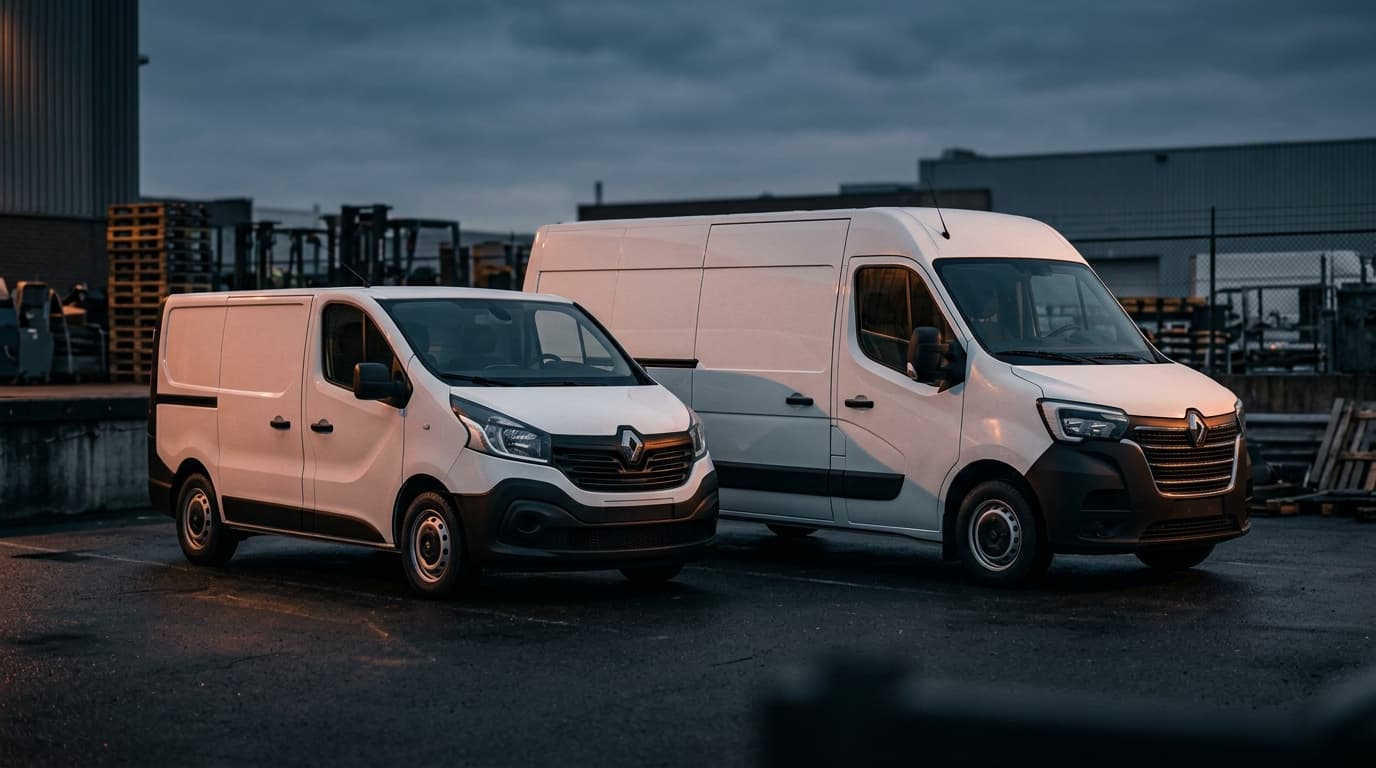
A medium van — Renault Trafic, Ford Transit Custom, Opel Vivaro — is enough as long as you stay under 6 to 7 m³ and mostly carry tools. You move up to a large van — Master, Ducato, Transit L3H2 — as soon as volume or bulky loads become regular, keeping an eye on the category-B licence and the real payload.
What is the real difference between a medium van and a large van?
The difference comes down to one word: volume. A medium van tops out around 6 to 7 m³; a large van starts where the medium stops, between 10 and 17 m³. Between the two, everything changes: size, roof height, GVW and behaviour in town.
The medium van is the core of the Belgian market: Trafic, Transit Custom, Vivaro, Expert, Transporter. Just under 5 metres long for the short versions, a roof that stays below 2 metres, and driving close to a large saloon. The large van plays in another league: Master, Ducato, Sprinter, Transit in L3H2 or L4, from 5.5 to over 6 metres, with a roof climbing to 2.50 m and beyond.
That height is easy to forget at purchase. On a real job site, it decides everything: a large van no longer clears the barrier of Belgian covered car parks, set between 1.90 m and 2.00 m. The medium van does.
What volume and payload for each category?
A medium van runs around 5.2 to 6.8 m³ and 1,000 to 1,300 kg of payload. A large van offers 10 to 17 m³, but its payload does not double for it: it stays capped by the GVW. Here are the benchmarks, common diesel versions.
| Criterion | Medium van | Large van |
|---|---|---|
| Typical models | Trafic, Transit Custom, Vivaro, Transporter | Master, Ducato, Transit L3H2, Sprinter |
| Overall length | 4.99–5.48 m | 5.4–6.4 m |
| Load volume | 5.2–6.8 m³ | 10–17 m³ |
| Payload | 1,000–1,300 kg | 1,000–1,600 kg |
| Overall height | < 2.00 m | 2.50 m and + |
| Diesel use | 7–9 L/100 km | 9–12 L/100 km |
The number that matters: a Renault Master L3H2 advertises 13 m³, a Trafic L2H1 about 6 m³. The volume doubles, but the payload often stays at the same level — around 1,100 to 1,300 kg once options are counted. In other words, the large van buys volume, not payload.
The consequence is concrete. If you carry heavy but compact — tiles, mortar bags, batteries — a medium van takes the load without trouble and you do not need the volume. If you carry bulky but light — furniture, insulation, boxes, plasterboard — the large van unlocks the situation, even without loading heavy.
Can you drive a large van on a category-B licence in Belgium?
Yes, as long as the GVW does not exceed 3,500 kg. In Belgium, the category-B licence allows driving up to 3.5 t maximum authorised mass (the MAM on the registration certificate). Above that, you need a C1 licence, valid up to 7.5 t.
Most large vans are homologated at exactly 3.5 t, precisely to stay within reach of a category-B licence. The trap is elsewhere: the payload is what remains between the van's kerb weight and that 3.5 t ceiling. The more the van is equipped — high roof, tail lift, timber fit-out — the higher the kerb weight and the more the real payload shrinks.
What we would avoid: loading a large van "by eye". A Fiat Ducato comes in a 3.5 t version (category B) and a Maxi 4.25 t (C1 licence): same lines, different obligations. Overloaded, you risk a fine, refusal of insurance cover after an accident, and accelerated wear. The reflex: read the GVW on the registration document before signing, not the sales brochure.
Medium van or large van: which for the city and low-emission zones?
For the dense city, the medium van wins hands down: it parks, clears car parks and uses less fuel. On low-emission zones, though, size changes nothing — the engine and Euro standard decide.
On the Belgian market, the LEZ rule does not look at the van's volume but at its age. Since 1 January 2026, Euro 5 diesel is banned in the Brussels LEZ, with fines starting on 1 July 2026 at €350 a year for the light commercial vehicles concerned. A recent Euro 6 diesel large van clears it; an ageing Euro 5 medium van does not. In Flanders, Antwerp and Ghent postponed their tightening, and Euro 5 diesel is still tolerated there in 2026.
Size, on the other hand, is paid on every urban trip. A large van 2.50 m tall shuts you out of underground car parks, complicates parking and pushes up the bodywork bill on bollards and barriers. For urban delivery or a tradesperson chaining city-centre jobs, the medium van stays the right tool.
Which is cheaper to run?
The medium van, on almost every line: fuel, insurance, servicing and resale. The large van is only justified if the volume saves you rounds or trips — otherwise you pay for empty air.
The fuel gap is the most visible. Count 2 to 3 litres per 100 km more for a large van. Over 25,000 km a year, that is 500 to 750 extra litres of diesel, or about €1,000 to €1,300 a year at current Belgian prices. Add insurance and servicing a notch above, and the large van costs noticeably more to run.
On tax, no difference between the two: a light commercial vehicle in 100% professional use recovers 100% of the VAT and stays 100% deductible, whether medium or large. Vans also escape the 2026 company-car reform. At resale, the medium van sells faster: the pool of used buyers for a Trafic or Transit Custom is wide in Belgium, whereas a large van targets a narrower audience.
When should you really move up to a large van?
Move up to a large van when volume regularly tops 6 to 7 m³, when you carry bulky loads — tall pallets, furniture, long items — or when you need to fit out a mobile workshop. Below that, the medium van does the job for less.
The right reflex is to size on your worst recurring load, not the exceptional case. A tradesperson who overflows a medium van once a quarter does not need to buy a large van: they rent that day and keep an economical vehicle the rest of the year.
And for an SME delivery fleet that is growing?
If rounds get denser and the medium van saturates on volume before it saturates on weight, the large van in L3H2 becomes worthwhile: fewer rotations, more parcels per stop. This is the typical case where the extra running cost is absorbed by the productivity gain.
And for heavy but compact loads?
Stay with the medium van. A medium van takes 1,000 to 1,300 kg in a contained volume: for dense material, you will hit the payload limit well before the volume limit. Moving up would only give you air to haul around.
Our verdict
There is no best format in the absolute, there is the format that fits your most frequent load. The medium van covers most tradespeople and small fleets: enough volume, honest payload, contained cost. The large van is reserved for regular volume and bulky loads, while watching the GVW to stay on a category-B licence and avoid running overloaded.
Before deciding, compare on what matters: our van comparator, the best medium van in Belgium and the best large van. Still hesitating one notch below? See city van or medium van.
Sources: FEBIAC (2025 light commercial vehicle registrations); Moniteur Automobile and Utilitaire Magazine (L2H2/L3H2 dimensions and volumes); SPF Mobility (category B and C1 licences); City of Brussels and Test-Achats (low-emission zones 2026); SPF Finances (VAT and deductibility of vans).
Grands fourgons comparator
Compare all grands fourgons side by side.
Compare now →
Frequently asked questions

Damien, 44 ans, a géré pendant douze ans la flotte d'utilitaires d'une PME de second œuvre dans la région de Namur : achats, entretien, revente, et les galères de carrosserie qui vont avec. Il a vu passer des dizaines de Trafic, Transporter et Master, et il sait ce qui casse, ce qui se revend bien et ce qui coûte cher à l'usage. Il a lancé ce site pour comparer les utilitaires sur ce qui compte vraiment en Belgique : charge utile réelle, volume utile, TVA récupérable et coût au kilomètre — pas la brochure du concessionnaire.