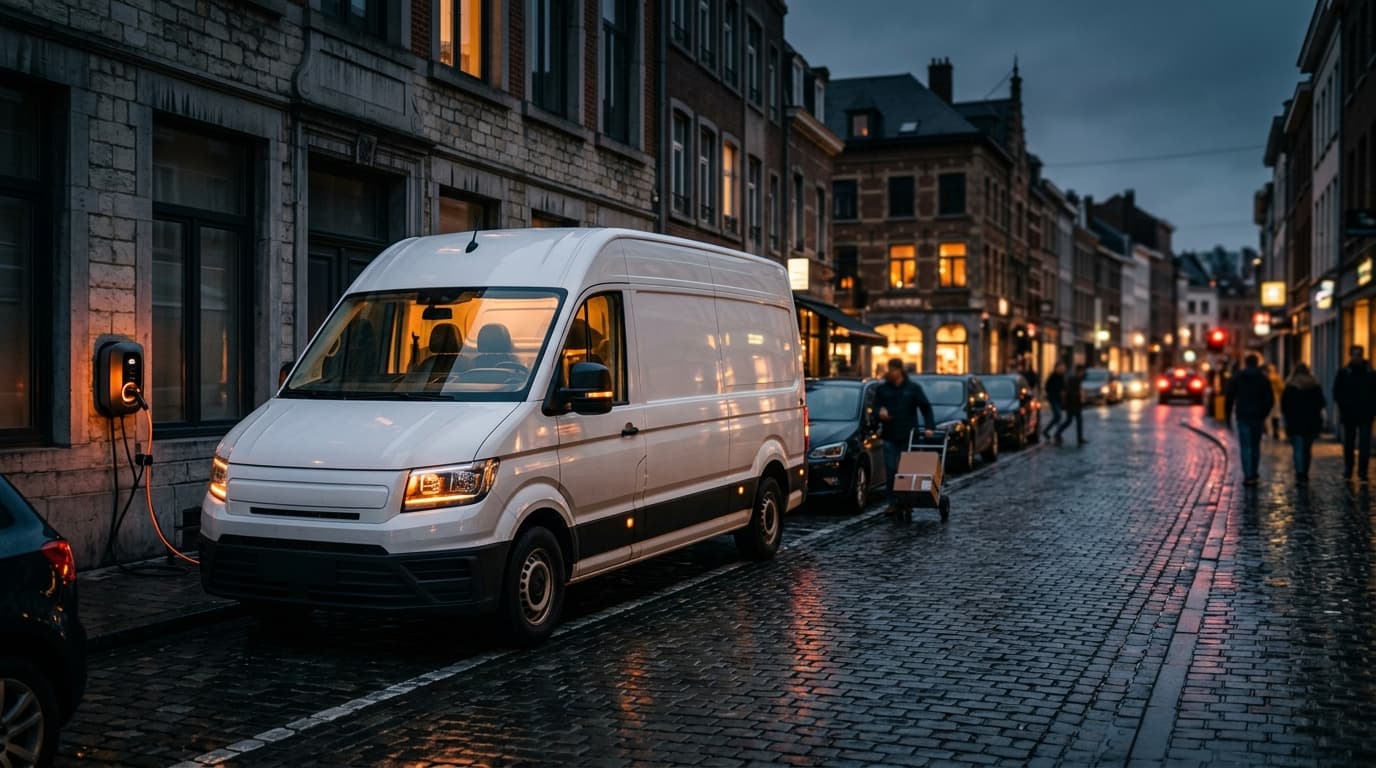
A move is won on a single number: volume. For a studio, 10 m³ is enough; for a house, you need to aim for 40 m³ or two trips. We went through the large vans sold in Belgium — Renault Master, Fiat Ducato, Mercedes Sprinter, Ford Transit — and the real buy-versus-rent question, category-B licence first.
Which large van to choose for a move, in short?
For a one-off move, rent a 12 to 20 m³ van rather than buying one: renting costs €29 to €150 a day, buying only makes sense for regular use. If you do buy, target volume (Ducato, Sprinter or Crafter up to 17 m³) and keep the GVW at 3.5 t to drive on a category-B licence.
A move does not follow the same logic as a delivery round. A courier fills the cube with light parcels; a mover alternates bulky boxes and heavy furniture. Load volume comes first, but payload decides how much you can carry before you are overweight.
The number that counts: a panel large van tops out around 17 m³. Beyond that, without moving up to a truck, there is only one option on a category-B licence — the 20 m³ box — at the cost of reduced payload. Everything else is a trade-off between those two ceilings.
How much volume do you need for your move?
Estimate the volume to carry first: about 10 m³ for a studio, 15 to 25 m³ for a one- to two-bedroom flat, and 40 m³ or more for a house. The quick rule: divide your living area by two or three for a ballpark figure in m³.
That cubage drives everything else. A standard moving box is about 0.1 m³, so around ten boxes per m³; a 50 m² flat averages 16 to 25 m³ once the furniture is added. Underestimate that volume and you are guaranteed three round trips on a rainy Saturday instead of one.
On a real move, it is better to slightly oversize: a half-full van drives better than one packed to the roof. For a well-furnished two-bedroom flat (around 25 m³), a single panel large van is not enough: either take a 20 m³ box and top it off with a small trip, or accept two runs. If your load includes heavy appliances, check the payload too — the category-B licence and payload topic is worth two minutes before you book.
Which large vans offer the most volume in Belgium?
As panel vans, the leading trio tops out at 17 m³: the Fiat Ducato (with its twins the Peugeot Boxer and Citroën Jumper), the Mercedes Sprinter and the VW Crafter, all in L4H3. The Renault Master stops around 14.8 m³, the Ford Transit around 15.1 m³. To go higher on a category-B licence, you have to leave the panel van and move to a box body.
These ceilings hide different personalities. The Ducato comes in three lengths (L2, L3, L4 from 5.41 to 6.36 m) and is the base of most motorhomes in Europe: known mechanicals, parts everywhere, easy resale. The Sprinter plays the premium card and driving comfort on long runs. The Master, redesigned in 2024, bets on payload (up to ~1,625 kg) and a low floor that makes carrying furniture easier.
On the Belgian market, you mostly meet these models in short-term rental, where companies line up bodied Master, Sprinter and Iveco Daily. The Iveco Daily, in fact, climbs higher on volume (up to ~19.6 m³) but often at a GVW above 3.5 t that tips into C1 licence territory — check before you book.
| Model (L4H3 panel van) | Max load volume | Indicative payload (3.5 t) | Max length |
|---|---|---|---|
| Fiat Ducato / Boxer / Jumper | ~17 m³ | ~1,200–1,500 kg | 6.36 m |
| Mercedes Sprinter | ~17 m³ | ~1,000–1,300 kg | 7.37 m |
| VW Crafter | ~17 m³ | ~1,000–1,400 kg | 7.39 m |
| Ford Transit | ~15.1 m³ | ~1,200–1,400 kg | 6.70 m |
| Renault Master (2024) | ~14.8 m³ | up to ~1,625 kg | 6.20 m |
| 20 m³ box (Luton) | ~20 m³ | often < 900 kg | ~7 m |
What we would avoid: choosing on catalogue volume alone. Once a tail lift and a bulkhead are fitted, real payload drops by 150 to 250 kg. To place these models outside the moving context, see our best large van in Belgium comparison.
Panel van or 20 m³ box: what can you drive on a B licence?
A category-B licence covers any vehicle up to 3.5 t GVW, 20 m³ box included. That is the biggest movable volume without a truck licence. But at constant GVW, the bigger the box, the smaller the payload: a 20 m³ box at 3.5 t often carries less than 900 kg.
The panel van and the box answer different needs. The panel van (up to 17 m³) stays manageable, parks almost like a small van and protects the load better from theft. The 20 m³ box — bodied chassis-cab, often with a tail lift — offers a straight volume, wide rear access and constant height, ideal for stacking boxes; in exchange, it takes up room, uses more fuel and needs more care in crosswinds.
On a real move, the 20 m³ box shines for a light but bulky home (a student, a flat-pack interior); a payload-focused panel van like the Master suits you better if you carry cast iron, machines or a well-stocked cellar. The number that decides remains the GVW: going over 3.5 t means a fine, an insurer that may dig in after an accident, and running gear that suffers.
Should you buy or rent a large van to move house?
For a one-off move, renting wins almost every time: €29 to €150 a day depending on size and company, without tying up €35,000 or handling maintenance and resale. Buying only makes sense if you move volume several times a month.
The Belgian rental market is dense. Dockx, Avis, Oscar, Sobeltax and Rentasix offer vans from 12 to 20 m³, often with a tail lift, straps, a sack truck and boxes as extras. Some allow one-way hire between cities, handy for a long-distance move. For a weekend, the bill is nowhere near the cost of buying.
Buying changes logic as soon as you talk regular professional use. A mover, a kitchen fitter or a furniture dealer amortises the vehicle, recovers the VAT and resells it after a few years. At resale, an ex-fleet Ducato or Sprinter finds a buyer quickly on the Belgian used market. For a private buyer who moves every five or ten years, that maths does not hold: rent.
Do you need a tail lift, and diesel or electric in 2026?
The tail lift is worth it if you load appliances or heavy furniture on your own: it spares your back and secures the manoeuvre. On the engine side, Euro 6 diesel stays the most rational for a move, with electric only worth it for repeated urban use with depot charging.
The tail lift has a price. It eats 150 to 250 kg of payload and adds several thousand euros to the purchase. For a move with several people, a ramp and a sack truck are often enough; the tail lift earns its keep for a solo mover or furniture over 80 kg.
The fuel question, meanwhile, has become regulatory. Since 1 January 2026, Euro 5 diesel is banned in the Brussels LEZ, with fines starting on 1 July 2026. A recent Euro 6 diesel van still gets in, and rental companies renew their fleets to stay compliant. Electric — Master E-Tech, E-Ducato, e-Sprinter — settles LEZ access, but its range drops with the load: count on 70 to 80% of the WLTP figure when fully loaded. For a one-day motorway move, diesel keeps the edge in time and peace of mind; to dig deeper, see our guide to the best electric van in Belgium.
How much VAT can you recover on a large van in Belgium?
Only professionals gain. A large van homologated as a utility vehicle and used 100% for business lets you recover 100% of the VAT and deduct it fully. For mixed use, the Belgian administration applies a flat rate: 85% if use is mainly professional, 35% if mainly private.
For a mover or a tradesperson who buys, the stake is real. On a van at €40,000 ex-VAT, going from 85% to 100% recovery is about €1,260 kept in the cash flow — provided you keep a clean logbook, the only document that justifies the rate in a tax check. Better still: unlike company cars, light commercial vehicles are exempt from the 2026 tax reform and stay 100% deductible, diesel or electric.
A private buyer moving once recovers nothing: no VAT, no deduction. That is the simplest financial argument for renting. Another market benchmark: in 2025, 70,797 light commercial vehicles were registered in Belgium (+7.6% vs 2024, FEBIAC), about 88% of them diesel — so used large vans are not scarce on the Belgian market. Not sure of your need? The comparator and the quiz point you in the right direction in two minutes.
Our verdict
A move is not a spec-sheet contest: it is a calculation of volume, weight and licence. A studio fits in a 12 m³ van rented for €40, a house calls for a 20 m³ box and two extra hands. Estimate your cubage, pick the right size, keep the GVW under the 3.5 t bar, and only sign a purchase if you move for others. The rest is logistics and coffee at 7 a.m.
Sources: FEBIAC (2025 light commercial vehicle registrations, +7.6%); Utilicare and Utilitaire Magazine (L4H3 volumes for Ducato, Sprinter, Crafter, Transit, Master); Groupe EDO (Mercedes Sprinter 2025 configurations and volumes); Avis Belgium, Dockx, Oscar and Rentasix (20 m³ van rental offers, category-B licence); Liftcity and Carrefour Location (moving volume estimation in m³); Bruxelles Environnement (2026 LEZ); FPS Mobility (B / C1 / C licence categories); FPS Finance (VAT and deductibility of light commercial vehicles).
Grands fourgons comparator
Compare all grands fourgons side by side.
Compare now →
Frequently asked questions

Damien, 44 ans, a géré pendant douze ans la flotte d'utilitaires d'une PME de second œuvre dans la région de Namur : achats, entretien, revente, et les galères de carrosserie qui vont avec. Il a vu passer des dizaines de Trafic, Transporter et Master, et il sait ce qui casse, ce qui se revend bien et ce qui coûte cher à l'usage. Il a lancé ce site pour comparer les utilitaires sur ce qui compte vraiment en Belgique : charge utile réelle, volume utile, TVA récupérable et coût au kilomètre — pas la brochure du concessionnaire.